Kern, Jerome D.
$295.00
1939 check in hand of, and signed by, the great Broadway & Hollywood composer!
Description
Type: Check
Description: (1885-1945) American musical theater and popular music composer. One of the most important American theatre composers of the early 20th century, he wrote 700+ songs used in over 100 stage works, incl. such classics as “Ol’ Man River”, “Can’t Help Lovin’ Dat Man” (both from the musical Showboat, which inaugurated the serious musical play in US theaters, with librettos by Oscar Hammerstein II), “A Fine Romance” “Smoke Gets In Your Eyes”, “They Didn’t Believe Me”, “The Song Is You”, “All the Things You Are”, “The Way You Look Tonight”, “Look For the Silver Lining”, and “Long Ago (and Far Away)”. He collaborated with many leading librettists and lyricists of his era, incl. George Grossmith Jr., Guy Bolton, P. G. Wodehouse, Otto Harbach, Oscar Hammerstein II, Dorothy Fields, Johnny Mercer, Ira Gershwin, and Yip Harburg.
A native New Yorker, Kern created dozens of Broadway musicals and Hollywood films in an over 4 decade career. His musical innovations, such as 4/4 dance rhythms and employment of syncopation and jazz progressions, built on, rather than rejected, earlier musical theatre tradition. He and his collaborators also employed his melodies to further the action or develop characterization to a greater extent than in the other musicals of his day, creating the model for later musicals. Although dozens of Kern’s musicals and musical films were hits, only Show Boat is regularly revived. Songs from his other shows, however, are still frequently performed and adapted. Many of Kern’s songs have been adapted by jazz musicians to become standard tunes.
Kern was a founding member of ASCAP in 1914. In May 1915, Kern was to sail with theater manager and producer Charles Frohman from New York to London on RMS Lusitania, but Kern missed the boat, having overslept after staying up late playing poker. Frohman died in the sinking of the ship. In 1929, Kern made his 1st t trip to Hollywood to supervise the 1929 film version of “Sally”, one of the first “all-talking” Technicolor films. “Roberta” (1933) by Kern and Harbach included the songs Smoke Gets in Your Eyes, Let’s Begin, and Yesterdays, and featured, among others, Bob Hope, Fred MacMurray, George Murphy, and Sydney Greenstreet, all in the early stages of their careers.
He wrote I Won’t Dance and Lovely to Look At, for the Fred Astaire and Ginger Rogers 1935 film version of “Roberta”, a hit. Their 1936 film, “Swing Time”, included the song The Way You Look Tonight, which won the 1936 Oscar for the best song. Other songs in “Swing Time” include A Fine Romance, Pick Yourself Up, and Never Gonna Dance.
In 1940, Hammerstein wrote the lyric The Last Time I Saw Paris in homage to the French capital recently occupied by the Germans. Kern set it, the only time he set a pre-written lyric, and his only hit song not written for a musical. A hit for Tony Martin and later for Noel Coward, it was used in the film “Lady Be Good” (1941) and won Kern another Oscar for best song.
Kern resided at the Beverly Wilshire Hotel in Beverly Hills, California, during the late 1930s, using it as a base for his work in film and music. He wrote, composed, and collaborated on music there before building his house on Whittier Drive. In fall 1945, Kern returned to New York to oversee auditions for a revival of “Show Boat”, and began work on the score for what would be the musical “Annie Get Your Gun”, to be produced by Rodgers and Hammerstein. On November 5, 1945, at age 60, he suffered a cerebral hemorrhage while walking at the corner of Park Avenue & 57th Street. Hammerstein was at his side in the hospital when Kern’s breathing stopped. Hammerstein hummed or sang the song I’ve Told Ev’ry Little Star from “Music in the Air” (a personal favorite of Kern’s) into Kern’s ear. Receiving no response, Hammerstein realized Kern had died. Rodgers and Hammerstein assigned the writing of the score for Annie Get Your Gun to Irving Berlin. Kern was nominated 8 times for an Academy Award, won twice; 7 nominations were for Best Original Song, incl. 1945 & 1946 posthumous nominations; a 1945 nomination was for Best Original Music Score.
Till the Clouds Roll By, a film biography of Kern, was released in 1946. Kern was inducted into the Songwriters Hall of Fame posthumously in 1970. In 1985, the US Post Office issued a 22c postage stamp with an illustration of Kern holding sheet music.
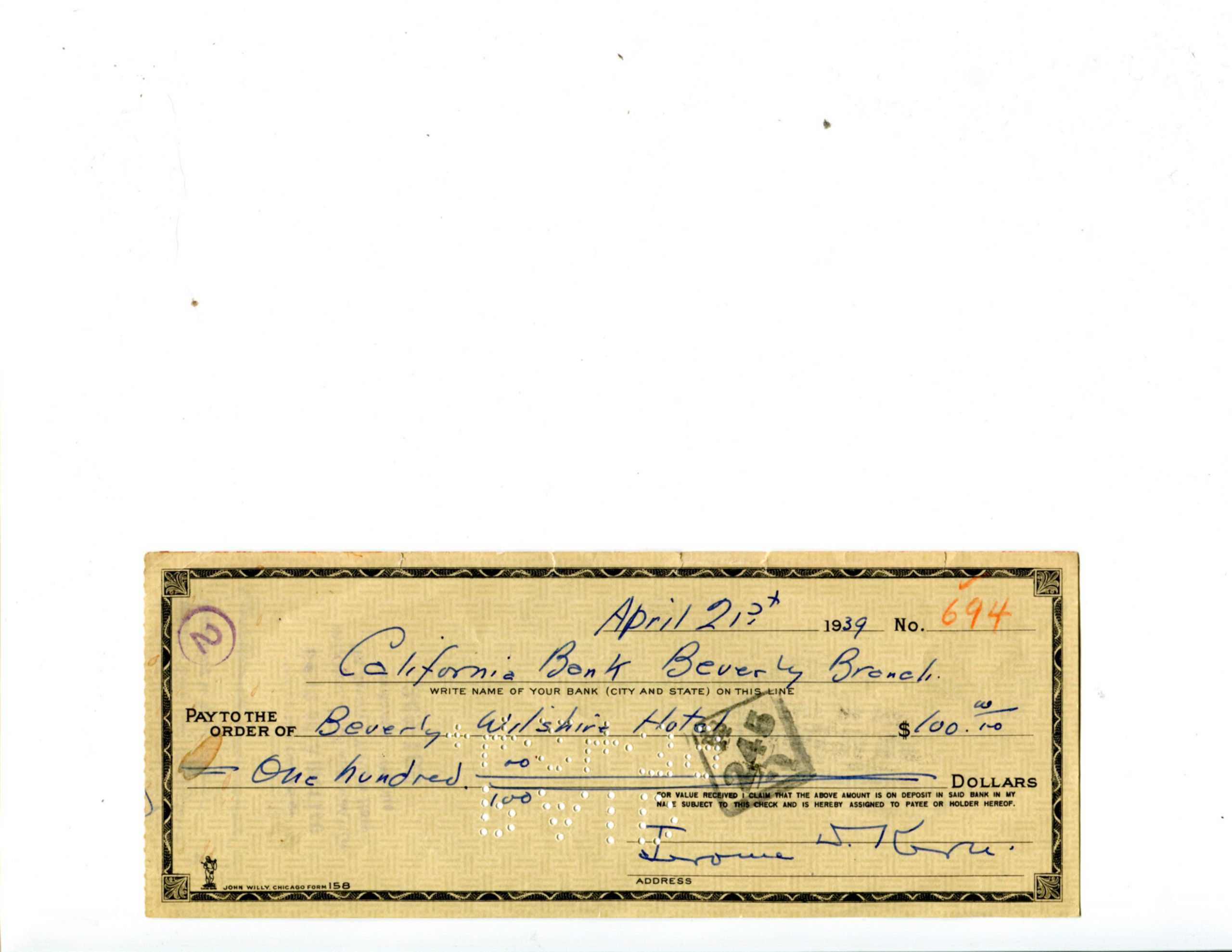
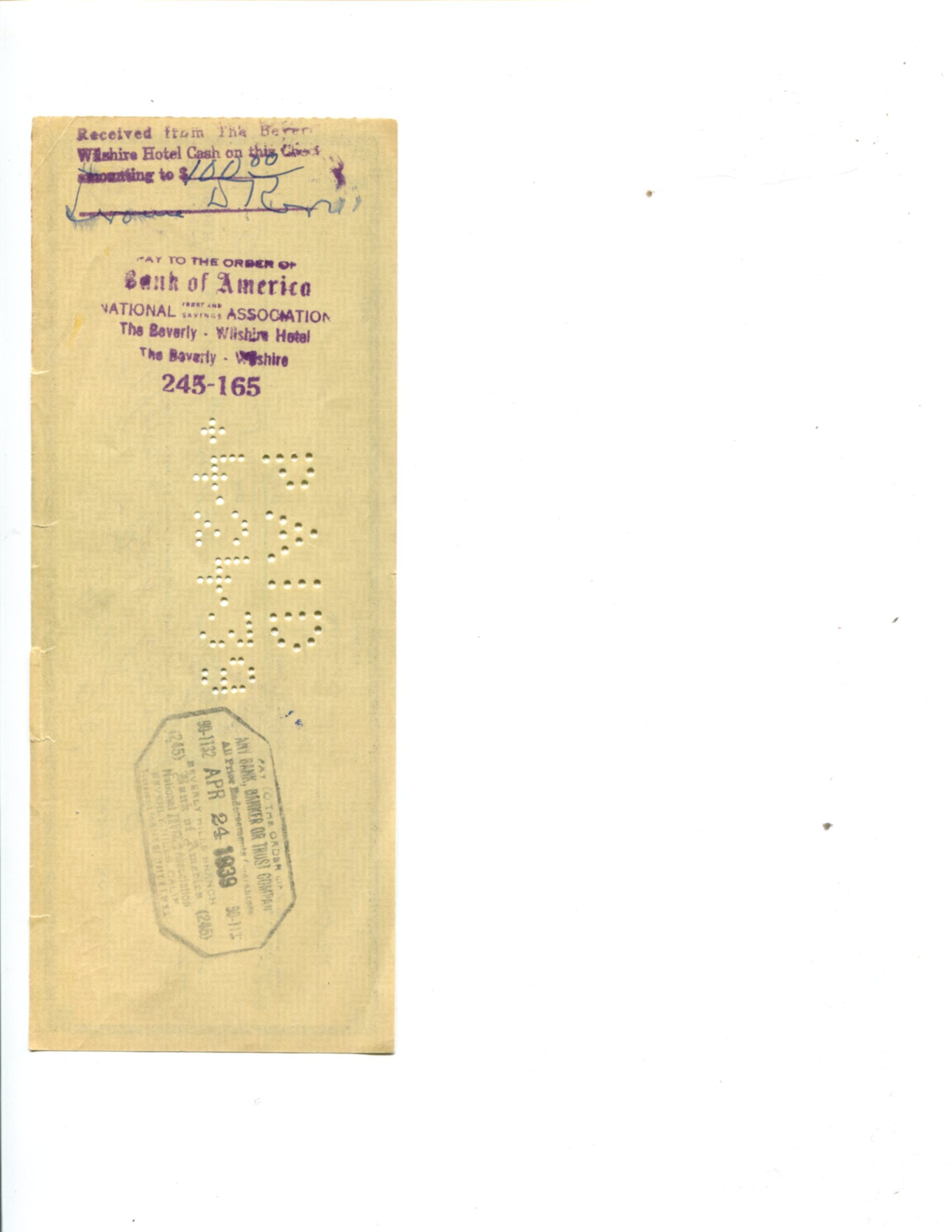
3 ¼ x 8 ¼ blank check filled in and signed by Kern, April 21, 1939, drawn on the California Bank Beverly Branch, pays $100 to the Beverly Wilshire Hotel (where he resided), signed also on verso.
Condition: Very good, slight spot at left edge, cancellation holes very slightly affect part of “J” in signature.