Belasco, David
$40.00
Famed American theater producer, impresario, director and playwright

Description
Type: Signed card
Description: (1853-1931) Sephardic-Jewish American theater producer, impresario, director and playwright, first writer to adapt short story Madame Butterfly for the stage. He launched theatrical careers of many actors, incl. James O’Neill, Mary Pickford, and Barbara Stanwyck, pioneered many innovative new forms of stage lighting and special effects to create realism and naturalism.
He began work in a San Francisco theater doing routine jobs, received 1st experience as a stage manager while on the road. From late 1873-early 1874, he worked as an actor, director, and secretary at Piper’s Opera House in Virginia City, Nevada; his developmental years as a supporting player there colored his thoughts and eventually helped him conceive realistic stage settings.
By March 1874, he was back in San Francisco, eventually managing Thomas Maguire’s Baldwin Theater. When Maguire lost the theater in 1882, Belasco relocated to the East Coast, bringing his practical western experiences with him. The West allowed him to develop his talents as not only a performer, but in progressive production design and execution.
A gifted playwright, Belasco went to New York in 1882 and worked as stage manager for the Madison Square Theatre (starting with Young Mrs. Winthrop), then the old Lyceum Theatre, also writing original plays. By 1895, he was most successful, considered America’s most distinguished playwright and producer.
During his 1884-1930 creative career, he either wrote, directed, or produced 100+ Broadway plays, incl. Hearts of Oak, The Heart of Maryland, and Du Barry, making him the most powerful personality on the New York City theater scene.
He helped establish careers for dozens of notable stage performers, many of whom went on to work in films. Among them were Mrs. Leslie Carter (dubbed “The American Sarah Bernhardt”) whose association with Belasco skyrocketed her to fame after her roles in Zara (1898) and Madame Du Barry (1901). Ina Claire’s’ lead in Polly with a Past (1917) and The Gold Diggers (1919) established her. Belasco wrote a lead part for 18-year-old Maude Adams for his 1890 play Men and Women which ran for 200 performances.
Other stars whose careers he helped launch incl. Jeanne Eagles, who later achieved immortality as Sadie Thompson in Rain (1923), which played for 340 performances. Belasco discovered and managed the careers of Lenore Ulric and David Warfield, both of whom became major Broadway stars. He launched Barbara Stanwyck’s career and was responsible for changing her name from Ruby Catherine Stevens.
Belasco is perhaps most famous for 2 works later adapted as highly popular operas. He adapted the short story Madame Butterfly as a play with the same name, and also wrote the play The Girl of the Golden West. Both were adapted as operas by Italian composer Giacomo Puccini. Also, 40+ motion pictures were made from plays that Belasco wrote.
Many late 19th and early 20th century prominent performers sought the opportunity to work with Belasco, incl. D. W. Griffith, Helen Hayes, Lillian Gish, Mary Pickford, and Cecil B. DeMille. He is credited as giving Pickford (b. Gladys Louise Smith) her stage name as well. He also worked with Lionel Barrymore, who starred in his play Laugh Clown, Laugh with Lucille Kahn, whose Broadway career Belasco launched. He was a member of The Lambs 1893-1931.
He brought a new standard of naturalism to the American stage as the first to develop modern stage lighting, along with use of colored lights via motorized color changing wheels, to evoke mood and setting. He became one of the 1st directors to eschew traditional footlights for lights concealed below floor level, hidden from the audience. In his own theatres, dressing rooms were equipped with lamps of several colors, allowing performers to see how their makeup looked under different lighting conditions.
Belasco embraced existing theatre technology and sought to expand on it. Both of his New York theatres were built on the cutting edge of their era’s technology. When Belasco took over the Republic Theatre, he drilled a new basement level to accommodate his machinery. He had the Stuyvesant Theatre specially constructed with great amounts of flyspace, hydraulics systems and lighting rigs. The basement of the Stuyvesant contained a working machine shop, where Belasco and his team experimented with lighting and other special effects. Many of the innovations developed in the Belasco shop were sold to other producers.
The 1st Belasco Theatre in New York was the Republic Theatre in Manhattan’s Theater District. He took over management of the theater and completely remodeled it in 1902, 2 years after it was constructed by Oscar Hammerstein (grandfather of the famous lyricist). It was rehabilitated and reopened as the New Victory Theater in 1995.
The 2nd Belasco Theatre, constructed in 1907 as the Stuyvesant Theatre, renamed after Belasco in 1910, built to his wishes, with Tiffany lighting and ceiling panels, rich woodwork and murals; his business office and private apartment were also housed there. The Belasco is still in operation as a Broadway venue with much of the original decor intact.
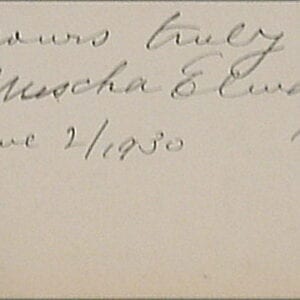
2 x 3 ¾ card with beveled edges, boldly signed.
Condition: Very good