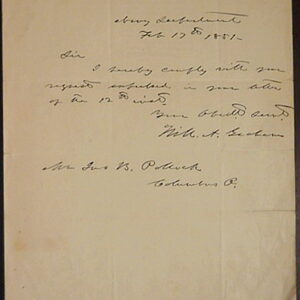
Alger, Russell A.
$30.00
McKinley’s Secretary of War during the Spanish-American War


Description
Type: Signed card
Description: 1836-1907) Michigan politician and businessman, served as the 20th governor of Michigan 1885-87, US Senator 1902-07, Secretary of War 1897-99. Alger’s life was a “rags-to-riches” success tale. He became an army officer, financier, lumber baron, railroad owner, and government official.
His parents died in 1848, leaving Russell the oldest of 3 orphaned children, without money and with a brother and sister to care for and support. He found homes for his brother and sister and got work on a farm, his remuneration was his board, clothes and the privilege of going to school 3 months out of the year. He studied law in Akron, admitted to the bar 1859; in 1860 he moved to Grand Rapids, entering the lumber business.
Her enlisted as a private on September 2, 1861 and became a captain and major in the 2nd Michigan Cavalry; in 3 years, he served in 66 different battles and skirmishes. On October 16, 1862 he was made lieut. colonel, 6th Michigan Cavalry. On February 28, 1863, he was promoted to colonel, 5th Michigan Cavalry, his command first to enter Gettysburg on June 28. Alger was considered a military strategist and surveyed Union supplies with President Lincoln. Alger was in Sheridan’s 1864 Valley Campaigns, and on June 11, 1864, at Trevilian Station, he captured a large force of Confederates with a brilliant cavalry charge. On July 8, 1864, Alger was severely wounded at Boonesborough, Maryland.
Alger resigned from the army Sept. 20, 1864. On Jan. 13, 1866, President Johnson nominated him as brevet brig. general of volunteers to rank from June 11, 1865; the Senate confirmed the award March 12, 1866. On Feb. 28, 1867, President Johnson nominated him brevet major general of volunteers to rank from June 11, 1865; the Senate confirmed him on March 2, 1867. In 1868, he was elected 1st commander of the Michigan department of the GAR. In 1889, he was the Grand Army’s National Commander-in-Chief. He was also a member of the Michigan Commandery of the Military Order of the Loyal Legion of the United States.
After the Civil War, Alger settled in Detroit as head of Alger, Smith & Company and the Manistique Lumbering Co. In order to transport the lumber, Alger led his company to create the Detroit Bay City and Alpena Railroad and served as president. Alger made a fortune logging the area which he used to propel himself to governor of Michigan
In 1884, Alger was elected Governor of Michigan, serving 1885-87 Highlights of his term included creation of the state board of pardons, founding of a veterans home in Grand Rapids, creation of 2 new counties (Alger and Iron) and establishing the Michigan College of Mines.
Alger’s name was placed in nomination for president at the 1888 GOP National Convention. Benjamin Harrison won nomination and won the general election.
On March 5, 1897, Alger was appointed Secretary of War in President McKinley’s cabinet. As Secretary, he recommended pay increases for military personnel serving at foreign embassies and legations, legislation to authorize a 2nd Assistant Secretary of War, and a constabulary force for Cuba, Puerto Rico, and the Philippines. He was criticized for inadequate preparation and inefficient operation of the department during the Spanish-American War, especially for his appointment of Wm. R. Shafter as leader of the Cuban expedition and the US Army beef scandal, in which poor-quality canned beef was supplied to the Army. “Algerism” became an epithet to describe the claimed incompetence of the Army. Alger resigned at McKinley’s request on August 1, 1899.
On Sept. 27, 1902, Alger was appointed by Michigan Governor Bliss to the US Senate to fill the vacancy caused by the death of James McMillan; he was elected to the seat by the Michigan legislature January 1903. Alger was chairman of the Senate Committee on Pacific Railroads in the 59th Congress
In May 1898, the War Department established Camp Russell A. Alger on a farm near Falls Church and Dunn Loring, Virginia. Faced with a typhoid epidemic, it was abandoned in August 1898 and sold the following month.
Named for him are a city in Michigan, a county, streets in Lincoln and Black River, and a neighborhood in Grand Rapids. In 1909, a monument to Alger was erected on the William G. Mather Building in Munising, and in 1921, a memorial fountain was dedicated to Alger in Grand Circus Park, Detroit by sculptor Daniel Chester French and architect Henry Bacon.
Signed 2 ¼ x 4 card as Secretary of War.
Condition: Very good